Showing posts with label flow. Show all posts

Sunday, March 25, 2012

Dinners & Lahars

The end of term is quickly approaching, and with all of next week taken up by sports activities at Montserrat Secondary School, I have finished all my teaching for this term. Speaking of which, it's been astoundingly fast how my time here has flown; it's hard to believe that I've been here for nearly three months now and I still find this island as fascinating as I did when I first arrived.

A lot of people who've lived here for awhile say that Montserrat is amazing to visit, but sometimes a challenge to live in. I'm not going to start weighing the pros and cons here, but I think having a purpose whilst living here does make it more enjoyable, and in my case this is proven to be a worthwhile effort. The Montserrat Youth Choir did another stellar performance, this time for the Rotary charter dinner which was held to raise funds for music resources on the island. The choir certainly did me proud, and I think they have managed to convince guests that their money will be certainly put into a worthy cause.

Demand for instrumental teaching continues to grow, but so far I have been stretched in terms of being able to offer individual one-to-one keyboard and piano lessons after school. I will be touching on this issue in my end of term report to the ministry, as I feel quite strongly about being able to equip students with basic instrumental skills in order to encourage them to explore their own musicality.

Earlier this month a group of MVO staff and myself (no, I'm not affiliated with MVO in any way) drove up the Belham river valley - for me, it was more of a sightseeing trip, but the MVO staff were there to take photos as part of some ongoing research. The Belham valley truly is an impressive sight - it has been devastated be repeated lahar flow, and much of what used to stand in the valley, such as hotels, villas and an entire golf course, are now buried under about 35 feet of hardened mud.

Lahar flows are deadly because of their energy and speed. Large lahar flows move at approximately sixty miles an hour, can flow for more than one hundred and ninety miles, and can cause catastrophic destruction in their path. The lahars from the Nevado del Ruiz eruption in Colombia in 1985 caused the Armero tragedy, which killed an estimated 23,000 when the city of Armero was buried under sixteen feet of mud and debris. New Zealand's Tangiwai disaster in 1953, where 151 people died after a Christmas Eve express train fell into the Whangaehu River, was caused by a lahar.

Here is a video containing some of the sights and sounds (ie. very loud, strong winds) which I captured on the Belham.


Having seen the valley from certain viewpoints previously did not quite prepare me for the scale of standing in the middle of it. Two days ago, the volcano started venting ash, reaching about 6,000 feet above sea level, approximately 3,000 feet above the volcano) - this activity was similar to activity previously observed prior to heavier volcanic activity, as last observed in 2008. However, the volcano has since calmed down, so I suppose that's about all the 'excitement' I'll get to witness.
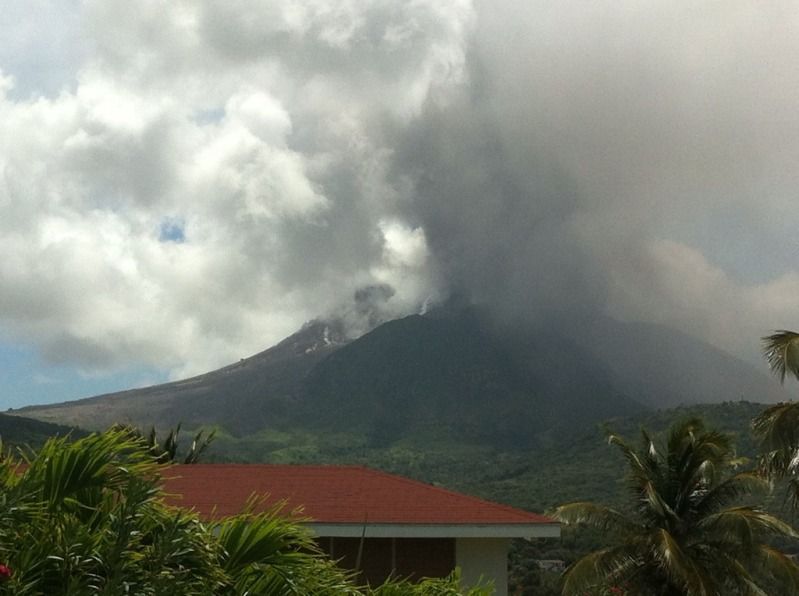
Soufriere Hills Volcano venting ash.

I drove to Old Towne during my lunch break on Friday to snap this photo, being quite excited about witnessing volcanic activity (however mild). However, the locals didn't even bat an eyelid - and after seeing what has happened to the Belham river valley, I'm not surprised.

Thursday, January 5, 2012

Ash & Pyroclastics

Yesterday I decided that my free time (so far) would be best spent driving around the island and orientating myself to the island. Montserrat itself isn't big; at 10 miles long and 6.8 miles wide, and more than half of it in the exclusion zone, it is significantly smaller than Singapore. However, it is extremely hilly - most of the populated areas are not along the coast, as there seems to be much less accessible shoreline that I first expected. Therefore a journey from Olveston (where I am, the southern part of the habitable area) to Brades (the de facto capital up north) takes at least twenty minutes.

With it being a tropical island with very little seasonal temperature variation, it is very much like being back in Singapore, except with the climate generally being a couple deg C lower and certainly less humidity levels. A lot of Montserrat does resemble Singapore sixty years ago - very rustic, rural and colonial in some ways.

One of the stops I made during my little island road trip was Jack Boy Hill, a secluded lookout spot in the northeast where I had a partial but picturesque view of the exclusion zone as well as the former airport which was abandoned during the last major eruption. It was quite surreal to see vast portions of land completely covered with hardened pyroclastic flow, rendering the entire landscape a dull grey - very much like a modern-day Pompeii.

A house completely destroyed by pyroclastic flow.

Coastline of the exclusion zone.

I also visited some of the (undestroyed) beaches along the west coast, with a popular one being Little Bay. This area is being redeveloped as the new capital town, with it being one of the more popular areas on weekends where bars and nightclubs open for business. The island's diving shops and facilities are also located here, so I hope to be spending some time there in the future when I decide to take up diving again!

Other practical considerations which I managed to suss out were the exact locations of the only two petrol stations on the island (they must be making a fortune!) as well as where some of the island's schools are located. At present I'm staying very near the only secondary school on the island, where I will be mostly based at. It seems I'll be starting work on Monday - can't wait. There are only so many free afternoons where I can sit on my porch all afternoon drinking beer and enjoying the sun.

View of the beach from Little Bay

You can tell from just exploring the island that Montserrat has come a long way since more than half the population were made refugees from volcanic activity in 1995. Everyone here seems to share a spirit of solidarity, spurred further on by a thoroughly friendly and amicable attitude. When I got out of my car at the supermarket and locked it, a local came up to me and said, "This is Montserrat, no need to lock your car!" Okay, maybe that will take some time getting used to.