Showing posts with label volcano. Show all posts

Friday, June 29, 2012

Write-ups & Recollections

About a month and a half ago I was invited to write down my experiences on Montserrat for the Guildhall School's student and alumni magazine, in order to give prospective applicants a brief introduction to life here. Now that it's been published, I'm reproducing it on the blog here.

Black sand beaches, goat racing and a volcano in the backyard, occasionally shrouded in mystic cloud cover. It’s no wonder Sir George Martin was enthralled by this place when he first visited in the seventies, enough so that he would then go on to set up AIR Studios Montserrat in 1979. And before the studio’s tragic demise during Hurricane Hugo in 1989, Montserrat was graced by a stellar line-up of artistes such as Sting, Elton John, Paul McCartney and Phil Collins, all of whom enjoyed recording in this paradise isle whilst enjoying a relative level of anonymity which could not be found in the big cities.
Then awoke the Soufrière Hills volcano in 1995 – this previously-dormant volcano suddenly erupted for the first time in the nineteenth century and changed the landscape of this small island permanently. With Soufrière Hills still active today, it’s hard to not mention the words ‘Montserrat’ and ‘volcano’ in the same conversation. 
Today, the Montserrat that I live and work in is vastly different from when the former capital Plymouth was still standing. Now, with more than half of the island in the exclusion zone, the population has declined from 10,500 to 4,800. While the islanders are ever so friendly with a resilient smile, they too feel the after-effects of this massive brain drain that happened along with the mass evacuations. Industries such as engineering, medicine, environmentalism and education have suffered, with little or no specialists in their respective field on the island. 
Still, Montserrat exudes a numinous sort of charm, which was first evident when I was flying in from Antigua on a seven-seater Britten-Norman Islander. Montserrat loomed in the distance, in a fashion that would not be out of place in a certain television series featuring a mysterious tropical island. The reason that took me across the Atlantic was because I responded to a call – Sir George and Lady Judy Martin were looking to send a music specialist to Montserrat to, in simplest terms, inspire young people to take on music. And I went. 
With a job description as vague as that, I was wielding a double-edged sword – I could plan and execute countless possibilities of music education programmes, but at the same time not knowing what support I would receive and what response I would get. Thankfully, being given tabula rasa in this sense allowed me to bite the bullet and start where I was most needed – in the secondary school. 
Montserrat has only one secondary school, with no formal scheme of music education in place before I arrived. And within 48 hours of boots touching the ground, I was tasked with planning and delivering the national music curriculum in the secondary school, running after-school music activities as well as wider-ops styled workshops for students and CPD sessions for professional musicians. 
Demand for instrumental teaching continues to grow, and lots of opportunities have opened up for expansion of music education on the island. I continue to set-up and support different music ensembles on the island that deal with young people, as well as raise awareness and highlight the necessity of music education within the school system. 
Montserrat certainly has a definitive legacy in recording industry, and while most of it has been lost with the eruption of the volcano, the community is working hard to restore it to its former glory. Projects such as the one I’m working on serve to build on that, giving the young people living here not only an avenue to explore their own musicality, but to take what they discover with them far and wide into the future. 
Currently, this project is sponsored and supported mainly by The Montserrat Foundation (UK), of which Sir George and Lady Judy Martin and both foundation trustees. It is also assisted by the Government of Montserrat, and the Rotary Club of Montserrat. I have been fortunate to be able to raise more funds to procure more music resources for the island, all of which are much-needed. Piano books, hand percussion instruments, and small things like rosin and valve oil - which, while you would ordinarily get any other music store back home, cannot be found here and must be specially ordered in. 
A lot of expats who have lived here for awhile will say Montserrat is amazing to visit, but sometimes a challenge to live in. Whilst avoiding the pitfall of calculative weighing of the pros and cons of such a situation, I must add that having a purpose whilst living here does make it more enjoyable, and in this case it has certainly proven to be a worthwhile effort. In one month you could be playing your first ever public steel pan gig, dance behind a truck loaded with massive speakers moving at half a mile an hour (this is called a jump up!), join in onstage with a Caribbean string band, or bet on your favourite caprid at the next goat race.


Sunday, March 25, 2012

Dinners & Lahars

The end of term is quickly approaching, and with all of next week taken up by sports activities at Montserrat Secondary School, I have finished all my teaching for this term. Speaking of which, it's been astoundingly fast how my time here has flown; it's hard to believe that I've been here for nearly three months now and I still find this island as fascinating as I did when I first arrived.

A lot of people who've lived here for awhile say that Montserrat is amazing to visit, but sometimes a challenge to live in. I'm not going to start weighing the pros and cons here, but I think having a purpose whilst living here does make it more enjoyable, and in my case this is proven to be a worthwhile effort. The Montserrat Youth Choir did another stellar performance, this time for the Rotary charter dinner which was held to raise funds for music resources on the island. The choir certainly did me proud, and I think they have managed to convince guests that their money will be certainly put into a worthy cause.

Demand for instrumental teaching continues to grow, but so far I have been stretched in terms of being able to offer individual one-to-one keyboard and piano lessons after school. I will be touching on this issue in my end of term report to the ministry, as I feel quite strongly about being able to equip students with basic instrumental skills in order to encourage them to explore their own musicality.

Earlier this month a group of MVO staff and myself (no, I'm not affiliated with MVO in any way) drove up the Belham river valley - for me, it was more of a sightseeing trip, but the MVO staff were there to take photos as part of some ongoing research. The Belham valley truly is an impressive sight - it has been devastated be repeated lahar flow, and much of what used to stand in the valley, such as hotels, villas and an entire golf course, are now buried under about 35 feet of hardened mud.

Lahar flows are deadly because of their energy and speed. Large lahar flows move at approximately sixty miles an hour, can flow for more than one hundred and ninety miles, and can cause catastrophic destruction in their path. The lahars from the Nevado del Ruiz eruption in Colombia in 1985 caused the Armero tragedy, which killed an estimated 23,000 when the city of Armero was buried under sixteen feet of mud and debris. New Zealand's Tangiwai disaster in 1953, where 151 people died after a Christmas Eve express train fell into the Whangaehu River, was caused by a lahar.

Here is a video containing some of the sights and sounds (ie. very loud, strong winds) which I captured on the Belham.


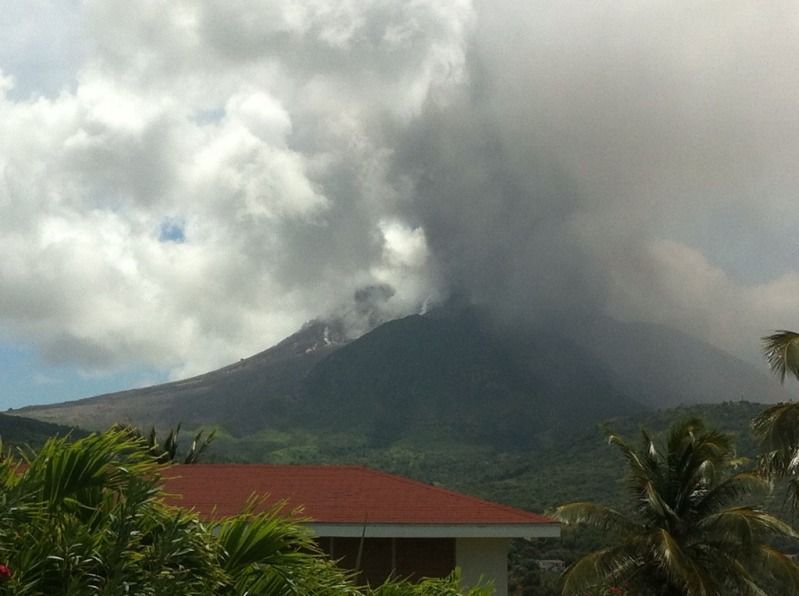
Having seen the valley from certain viewpoints previously did not quite prepare me for the scale of standing in the middle of it. Two days ago, the volcano started venting ash, reaching about 6,000 feet above sea level, approximately 3,000 feet above the volcano) - this activity was similar to activity previously observed prior to heavier volcanic activity, as last observed in 2008. However, the volcano has since calmed down, so I suppose that's about all the 'excitement' I'll get to witness.

Soufriere Hills Volcano venting ash.

I drove to Old Towne during my lunch break on Friday to snap this photo, being quite excited about witnessing volcanic activity (however mild). However, the locals didn't even bat an eyelid - and after seeing what has happened to the Belham river valley, I'm not surprised.

Friday, February 17, 2012

Volcanoes & Work schemes


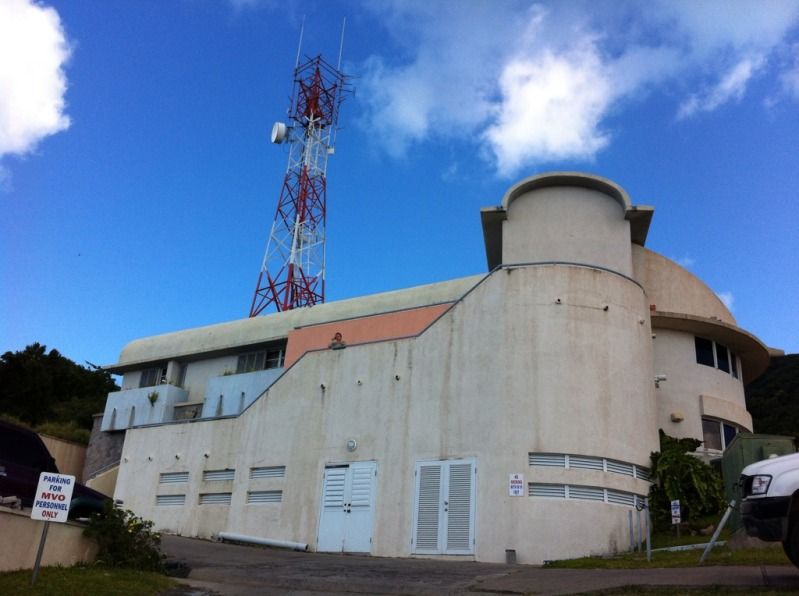
After six weeks on the island, I finally made a trip up to the Montserrat Volcano Observatory (MVO) to pay a visit. Having got to know quite a few scientists and staff who work at MVO, I thought it would be nice to spend my half term holiday up at MVO to see what actually goes on there. Half term here, by the way, is one day. Not one week. Gotta learn how to treasure it!

The MVO's main function, as you can imagine, is to closely monitor volcanic activity coming from the Soufriere Hills volcano, as well as issue travel advisories for the exclusion zone. Although pyroclastic activity has more or less ceased today and eruption continues on a much reduced scale (such as a few rockfalls, etc.), Soufriere Hills has in the past caught Montserrat and its residents by surprise on a number of occasions - with the most severe impact being, of course, the eruption on 25 June 1997 which resulted in the deaths of nineteen people.

Since its eruption began, the volcano has become one of the most closely monitored volcanoes in the world. The MVO takes detailed measurements and reports on its activity to the government and people of Montserrat. A typical MVO visit consists of a self-guided tour and activities include poster displays detailing information about past volcanic activity, a short documentary film and displays of rocks, ash and other artefacts. And of course, stunning views of Soufriere Hills

On approach to the MVO.

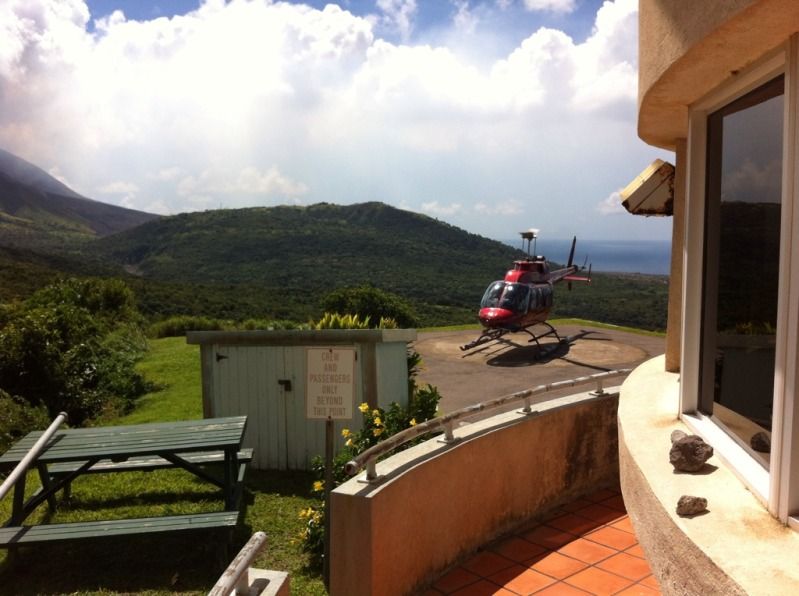
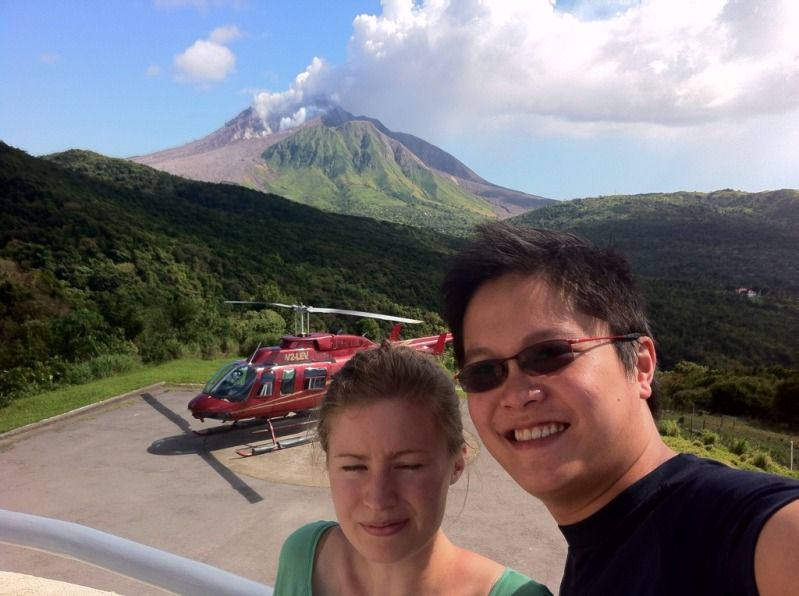
Every Friday is helicopter day.

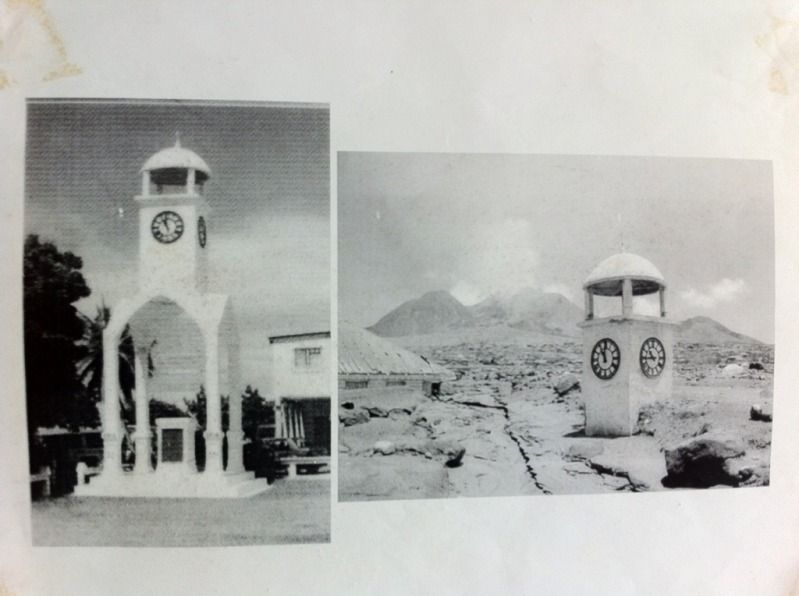
A stark example of how pyroclastic flow destroyed Plymouth.

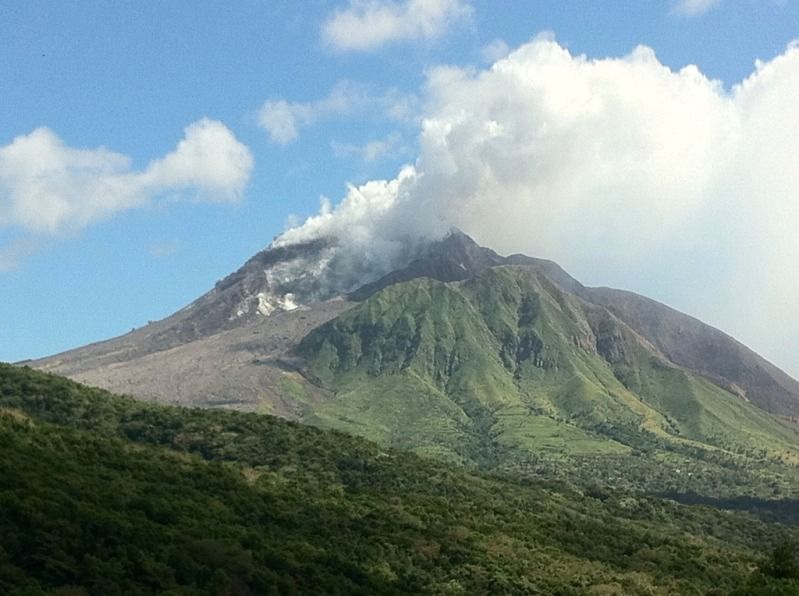
A relatively clear day for volcano admiring.

With Mel, one of the MVO volunteers.

The documentary film was very informative, and showed impressive scenes of Soufriere Hills at its peak in activity - it's hard to imagine how this calm, beautiful scene today can in fact be so immensely beguiling. Compare this to when it was erupting back in 1995 with these pictures here and here.

This past week has gone by relatively quick - with no teaching on Wednesday and Friday due to Parents' Day and half term respectively. I met quite a number of parents on Wednesday, and so far all the feedback has been really positive and encouraging. In actual fact, I realize that the focus what I came here to do initially has shifted quite a bit. Prior to starting work here, I thought I would be running a more after-school based music programme and service. However, the focus has now changed to establishing a music curriculum for Montserrat Secondary School, and implementing a work scheme to be delivered in classrooms.

A lot of this sounds very education- and teacher-based, and it has been indeed. At the moment I am planning and delivering lesson plans for Years 7-9, spread out to a total of 10 different classes. Compared to a normal teaching timetable back home, this is definitely more than a normal full teaching timetable. Combine that with after-school activities such as choir and peripatetic teaching, this translates to a lot of hours spent solely with MSS.

However, given the current state of music education and outreach on the island, it would be hard to establish a 'wider ops'-styled programme when the nucleus of formal music education in schools is yet to be properly established. I have decided that my main aim, for MSS at least, is to sustain a keen level of interest amongst students so that they continuing taking music as a subject option and, finally, take music as an O-level subject in their CXC examinations in Year 11.

This will require a constant occupancy of the role of music specialist in MSS, and I hope this is something that the Foundation is willing to support in the years to come. Having being trained in music education and outreach, as well as workshop skills, has nonetheless helped me immensely in delivering a music curriculum in the classroom - combing different teaching methods and approaches seems to have spurred continual interest amongst students, even though the topics covered could be as basic as music notation.

The current plan is to widen the music subject to Years 10 & 11 as well, however I think this will require at least two full time music specialists within MSS - just like any other regular school in the UK. I think there is a very fine line between 'music teacher' and 'wider-ops workshop leader' here, although I have found both roles to be quite interchangeable most of the time.

In other community-based project news, rehearsals for Volpanics is now in full swing and I'm now in the midst of doing up an arrangement for Big Spender on pan orchestra - which I'm quite excited about. I am also drawing up a proposal to conduct CPD weekends for professional musicians, music educators and music practitioners in Montserrat. Truth be told, setting up new projects can be quite a lengthy affair - ministry officials seem to have quite a pre-defined mindset about how music education, activities and programmes should be conducted, and any new projects always seem to be met with quite a lot of initial apprehension.

I shall now leave you with other scenes I've recently encountered over here - and since a royal visit is approaching, here's an apt photo of Prince of Wales & Duchess of Cornwall's guestbook entry in Government House, the official residence of the governor of Montserrat.

Charles and Camilla leave their mark.

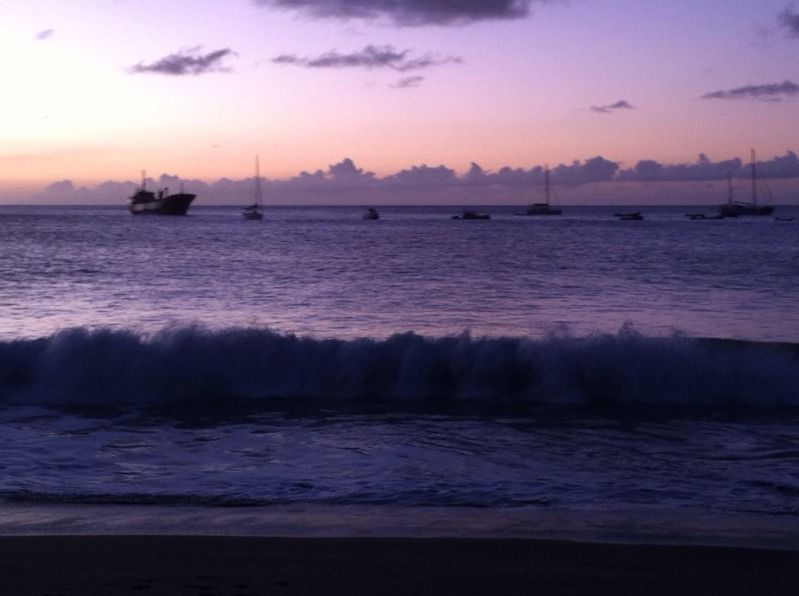
Sunset at Little Bay on Valentine's Day

Tomorrow marks the fifth round of Montserrat Idol - things certainly are heating up! Should you find yourself curious about the ongoings, you can watch scenes on PTVMontserratIdol.com and catch the live stream every Saturday at 1am UTC.
Thursday, January 5, 2012

Ash & Pyroclastics

Yesterday I decided that my free time (so far) would be best spent driving around the island and orientating myself to the island. Montserrat itself isn't big; at 10 miles long and 6.8 miles wide, and more than half of it in the exclusion zone, it is significantly smaller than Singapore. However, it is extremely hilly - most of the populated areas are not along the coast, as there seems to be much less accessible shoreline that I first expected. Therefore a journey from Olveston (where I am, the southern part of the habitable area) to Brades (the de facto capital up north) takes at least twenty minutes.

With it being a tropical island with very little seasonal temperature variation, it is very much like being back in Singapore, except with the climate generally being a couple deg C lower and certainly less humidity levels. A lot of Montserrat does resemble Singapore sixty years ago - very rustic, rural and colonial in some ways.

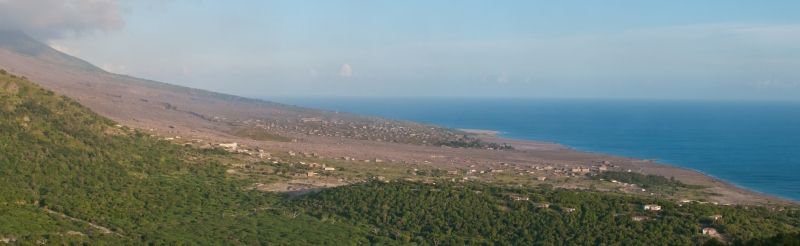
One of the stops I made during my little island road trip was Jack Boy Hill, a secluded lookout spot in the northeast where I had a partial but picturesque view of the exclusion zone as well as the former airport which was abandoned during the last major eruption. It was quite surreal to see vast portions of land completely covered with hardened pyroclastic flow, rendering the entire landscape a dull grey - very much like a modern-day Pompeii.

A house completely destroyed by pyroclastic flow.

Coastline of the exclusion zone.

I also visited some of the (undestroyed) beaches along the west coast, with a popular one being Little Bay. This area is being redeveloped as the new capital town, with it being one of the more popular areas on weekends where bars and nightclubs open for business. The island's diving shops and facilities are also located here, so I hope to be spending some time there in the future when I decide to take up diving again!

Other practical considerations which I managed to suss out were the exact locations of the only two petrol stations on the island (they must be making a fortune!) as well as where some of the island's schools are located. At present I'm staying very near the only secondary school on the island, where I will be mostly based at. It seems I'll be starting work on Monday - can't wait. There are only so many free afternoons where I can sit on my porch all afternoon drinking beer and enjoying the sun.

View of the beach from Little Bay

You can tell from just exploring the island that Montserrat has come a long way since more than half the population were made refugees from volcanic activity in 1995. Everyone here seems to share a spirit of solidarity, spurred further on by a thoroughly friendly and amicable attitude. When I got out of my car at the supermarket and locked it, a local came up to me and said, "This is Montserrat, no need to lock your car!" Okay, maybe that will take some time getting used to.

Wednesday, January 4, 2012

Antigua & Mini-planes

So, here we go. Day 1 on this tropical paradise isle that is Montserrat. Well, I say paradise - that's from what I've seen so far when the Britten-Norman Islander I was in flew above Montserrat as it approached landing. The day started early yesterday with a delayed & packed flight to Antigua from London Gatwick, brought on by terrible gales lashing the runway. By then I was quite grateful to be leaving such foul weather to sunnier lands.

After a very quick & hectic layover in Antigua, I found myself onboard a six-seater Islander aircraft - the only type of aircraft that FlyMontserrat operates - heading towards the Emerald Isle, pop. 4,822, along with three other fellow passengers. Whilst en-route I got to know another passenger who was also starting a new job in Montserrat - the new customs head, who himself also travelled from London. There was indeed a moment of hilarity which ensued when he, having arrived without making himself known to customs that he was their new boss, was asked to step behind the yellow line and wait his turn.

There are currently only two ways to get to and from Montserrat. The first is either a 40-minute long ferry ride or a 20-minute long flight, both from Antigua. Montserrat's former airport, along with the former capital Plymouth, were destroyed in the 1997 eruption of Soufriere Hills volcano. For several years afterwards, Montserrat had been only accessible by helicopters or boats until July 2005 when the new John A. Osborne Airport was completed on the north end of the island, prompting flight services to resume.

The pilot & stewardess. Talk about cosy.

Upon landing, I was picked up by representatives from Montserrat Enterprises, then driven to the police station to obtain my local temporary driver's license before being shown to my accommodation. For the next seven-months I'll be put up in the lower half of a colonial-era styled house which has been divided into two apartments, one on the ground floor and the other on the first. I still have yet to meet my neighbour(s), but let's hope they weren't too put off with me blasting the local radio belting out hits from Enrique Igleasis and Westlife (I like this place already!) whilst I was doing my unpacking.

Day One has thus kicked off in the most relaxed manner possible. Last night I sent out a deluge of emails checking-in with the various powers-that-be that I would be working with, but I still have yet to get any response regarding official meetings or school tours. Perhaps I'm just still stuck in hectic big city mode and need to take time to calm down and adapt to the Montserratian way of life.

I have been invited to dinner with the governor of Montserrat, Sir George Martin and their respective families tomorrow. Time to start all that ironing!