Showing posts with label resources. Show all posts

Friday, June 29, 2012

Write-ups & Recollections

About a month and a half ago I was invited to write down my experiences on Montserrat for the Guildhall School's student and alumni magazine, in order to give prospective applicants a brief introduction to life here. Now that it's been published, I'm reproducing it on the blog here.

Black sand beaches, goat racing and a volcano in the backyard, occasionally shrouded in mystic cloud cover. It’s no wonder Sir George Martin was enthralled by this place when he first visited in the seventies, enough so that he would then go on to set up AIR Studios Montserrat in 1979. And before the studio’s tragic demise during Hurricane Hugo in 1989, Montserrat was graced by a stellar line-up of artistes such as Sting, Elton John, Paul McCartney and Phil Collins, all of whom enjoyed recording in this paradise isle whilst enjoying a relative level of anonymity which could not be found in the big cities.
Then awoke the Soufrière Hills volcano in 1995 – this previously-dormant volcano suddenly erupted for the first time in the nineteenth century and changed the landscape of this small island permanently. With Soufrière Hills still active today, it’s hard to not mention the words ‘Montserrat’ and ‘volcano’ in the same conversation. 
Today, the Montserrat that I live and work in is vastly different from when the former capital Plymouth was still standing. Now, with more than half of the island in the exclusion zone, the population has declined from 10,500 to 4,800. While the islanders are ever so friendly with a resilient smile, they too feel the after-effects of this massive brain drain that happened along with the mass evacuations. Industries such as engineering, medicine, environmentalism and education have suffered, with little or no specialists in their respective field on the island. 
Still, Montserrat exudes a numinous sort of charm, which was first evident when I was flying in from Antigua on a seven-seater Britten-Norman Islander. Montserrat loomed in the distance, in a fashion that would not be out of place in a certain television series featuring a mysterious tropical island. The reason that took me across the Atlantic was because I responded to a call – Sir George and Lady Judy Martin were looking to send a music specialist to Montserrat to, in simplest terms, inspire young people to take on music. And I went. 
With a job description as vague as that, I was wielding a double-edged sword – I could plan and execute countless possibilities of music education programmes, but at the same time not knowing what support I would receive and what response I would get. Thankfully, being given tabula rasa in this sense allowed me to bite the bullet and start where I was most needed – in the secondary school. 
Montserrat has only one secondary school, with no formal scheme of music education in place before I arrived. And within 48 hours of boots touching the ground, I was tasked with planning and delivering the national music curriculum in the secondary school, running after-school music activities as well as wider-ops styled workshops for students and CPD sessions for professional musicians. 
Demand for instrumental teaching continues to grow, and lots of opportunities have opened up for expansion of music education on the island. I continue to set-up and support different music ensembles on the island that deal with young people, as well as raise awareness and highlight the necessity of music education within the school system. 
Montserrat certainly has a definitive legacy in recording industry, and while most of it has been lost with the eruption of the volcano, the community is working hard to restore it to its former glory. Projects such as the one I’m working on serve to build on that, giving the young people living here not only an avenue to explore their own musicality, but to take what they discover with them far and wide into the future. 
Currently, this project is sponsored and supported mainly by The Montserrat Foundation (UK), of which Sir George and Lady Judy Martin and both foundation trustees. It is also assisted by the Government of Montserrat, and the Rotary Club of Montserrat. I have been fortunate to be able to raise more funds to procure more music resources for the island, all of which are much-needed. Piano books, hand percussion instruments, and small things like rosin and valve oil - which, while you would ordinarily get any other music store back home, cannot be found here and must be specially ordered in. 
A lot of expats who have lived here for awhile will say Montserrat is amazing to visit, but sometimes a challenge to live in. Whilst avoiding the pitfall of calculative weighing of the pros and cons of such a situation, I must add that having a purpose whilst living here does make it more enjoyable, and in this case it has certainly proven to be a worthwhile effort. In one month you could be playing your first ever public steel pan gig, dance behind a truck loaded with massive speakers moving at half a mile an hour (this is called a jump up!), join in onstage with a Caribbean string band, or bet on your favourite caprid at the next goat race.


Saturday, April 21, 2012

Concrete walls & Rosin

The first week of the summer term has passed quickly, with lots of lesson planning taken care of and many an hour spent in front of the photocopying machine. The past week has also been rather rainy and cool, which I hear has been a welcome break from the very hot weather Montserrat had been experiencing during the two weeks I was away. Ironically, London was still in the grips of some unseasonably cold weather when I was there.

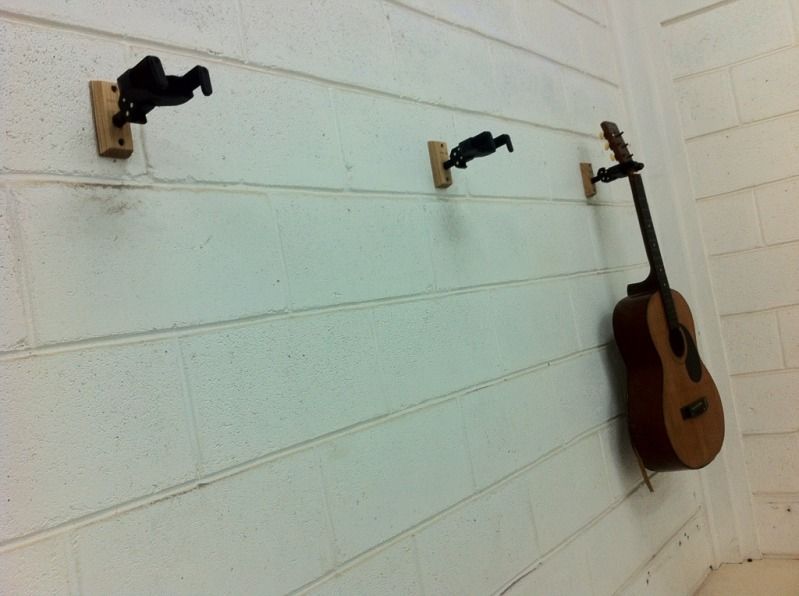
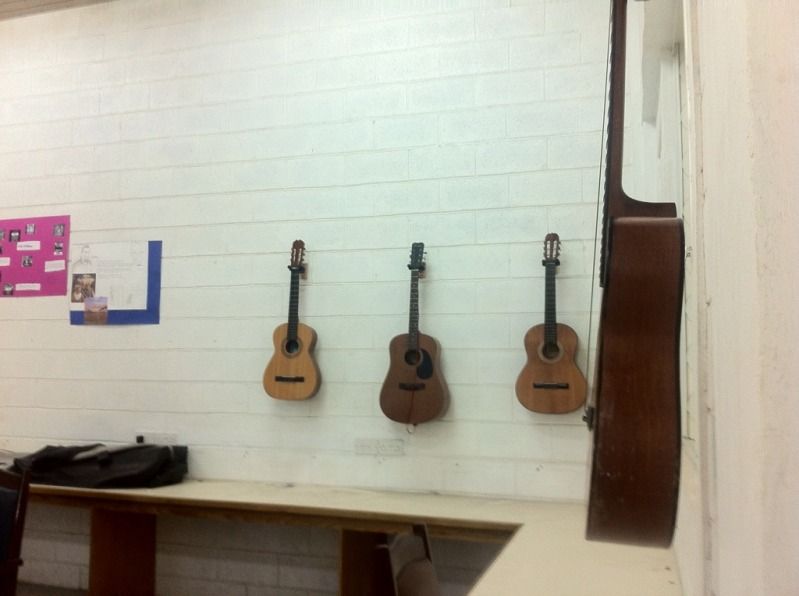
Being in London over the Easter break gave me the opportunity to procure lots more resources for the island. Piano and music theory books, and small things like rosin and valve oil - which, while you would ordinarily get any other music store back home, cannot be found here and must be specially ordered in. I also managed to get some wall guitar hangers which, apart from doing what it does, always look good when it comes to sprucing up the image of a music classroom!

I have to say though, the walls that make up buildings over here are strong enough to withstand a hurricane - no pun intended. My classroom walls were made up of extremely sturdy and tough concrete brick, and the accompanying drill bits which came with the borrowed drill barely put a dent in it. So I had to run to the hardware store and pick up a new set of drill bits, and after screwing in five guitar hangers (two screws each), I had broken one in half, chipped off another, and two more are now too blunt to do anything.

Maybe I need a proper lesson in drilling school.

Battling with the walls.

All set up and good to go.

Having had a term to set up the old Salem Primary as the new designated music education 'centre' for the island is paying off well - we now are slowly amassing a steady stream of instrumental donations which will be taken care of looked after. The primary school wider-ops music programme Small Beginnings will also now be run from the new location in Salem. I am still in need for more wall guitar hangers (I only had enough space for a maximum of five to bring over), as well as basic keyboard damper pedals.

And from the looks of it, another new set of drill bits.

The Xinjiang Folk Dance which we did last month was recorded again, this time at Government House with full costumes and in proper HD! After trying to attempt some slick, multi-camera angle video editing on the frustratingly basic Windows Live Movie Maker, here's the result!


Sunday, March 25, 2012

Dinners & Lahars

The end of term is quickly approaching, and with all of next week taken up by sports activities at Montserrat Secondary School, I have finished all my teaching for this term. Speaking of which, it's been astoundingly fast how my time here has flown; it's hard to believe that I've been here for nearly three months now and I still find this island as fascinating as I did when I first arrived.

A lot of people who've lived here for awhile say that Montserrat is amazing to visit, but sometimes a challenge to live in. I'm not going to start weighing the pros and cons here, but I think having a purpose whilst living here does make it more enjoyable, and in my case this is proven to be a worthwhile effort. The Montserrat Youth Choir did another stellar performance, this time for the Rotary charter dinner which was held to raise funds for music resources on the island. The choir certainly did me proud, and I think they have managed to convince guests that their money will be certainly put into a worthy cause.

Demand for instrumental teaching continues to grow, but so far I have been stretched in terms of being able to offer individual one-to-one keyboard and piano lessons after school. I will be touching on this issue in my end of term report to the ministry, as I feel quite strongly about being able to equip students with basic instrumental skills in order to encourage them to explore their own musicality.

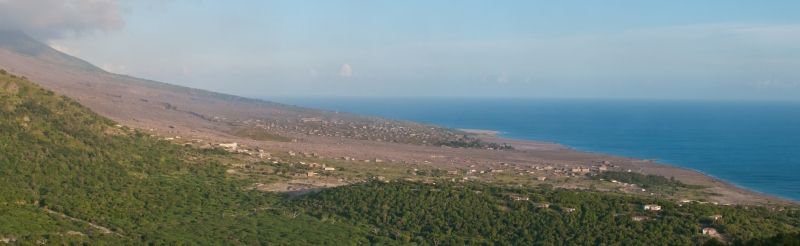
Earlier this month a group of MVO staff and myself (no, I'm not affiliated with MVO in any way) drove up the Belham river valley - for me, it was more of a sightseeing trip, but the MVO staff were there to take photos as part of some ongoing research. The Belham valley truly is an impressive sight - it has been devastated be repeated lahar flow, and much of what used to stand in the valley, such as hotels, villas and an entire golf course, are now buried under about 35 feet of hardened mud.

Lahar flows are deadly because of their energy and speed. Large lahar flows move at approximately sixty miles an hour, can flow for more than one hundred and ninety miles, and can cause catastrophic destruction in their path. The lahars from the Nevado del Ruiz eruption in Colombia in 1985 caused the Armero tragedy, which killed an estimated 23,000 when the city of Armero was buried under sixteen feet of mud and debris. New Zealand's Tangiwai disaster in 1953, where 151 people died after a Christmas Eve express train fell into the Whangaehu River, was caused by a lahar.

Here is a video containing some of the sights and sounds (ie. very loud, strong winds) which I captured on the Belham.


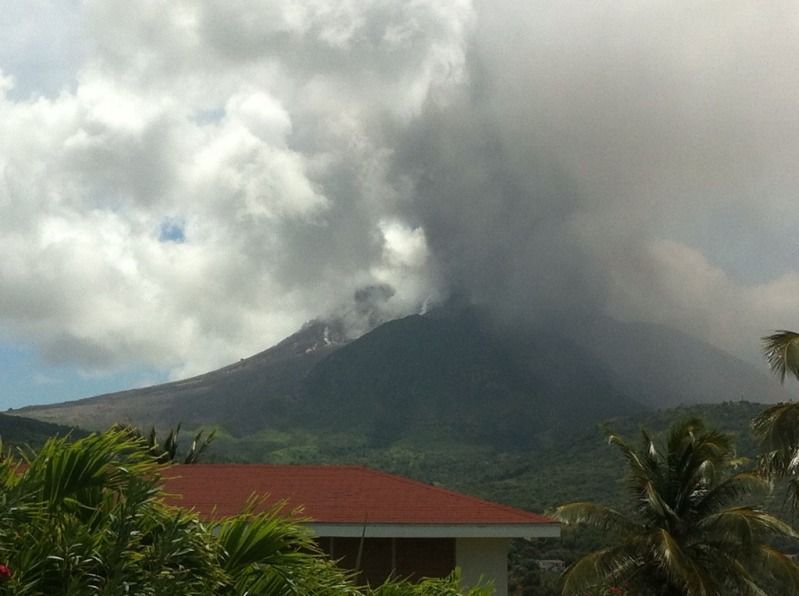
Having seen the valley from certain viewpoints previously did not quite prepare me for the scale of standing in the middle of it. Two days ago, the volcano started venting ash, reaching about 6,000 feet above sea level, approximately 3,000 feet above the volcano) - this activity was similar to activity previously observed prior to heavier volcanic activity, as last observed in 2008. However, the volcano has since calmed down, so I suppose that's about all the 'excitement' I'll get to witness.

Soufriere Hills Volcano venting ash.

I drove to Old Towne during my lunch break on Friday to snap this photo, being quite excited about witnessing volcanic activity (however mild). However, the locals didn't even bat an eyelid - and after seeing what has happened to the Belham river valley, I'm not surprised.