About a month and a half ago I was invited to write down my experiences on Montserrat for the Guildhall School's student and alumni magazine, in order to give prospective applicants a brief introduction to life here. Now that it's been published, I'm reproducing it on the blog here.
Black sand beaches, goat racing and a volcano in the
backyard, occasionally shrouded in mystic cloud cover. It’s no wonder Sir
George Martin was enthralled by this place when he first visited in the
seventies, enough so that he would then go on to set up AIR Studios Montserrat
in 1979. And before the studio’s tragic demise during Hurricane Hugo in 1989,
Montserrat was graced by a stellar line-up of artistes such as Sting, Elton
John, Paul McCartney and Phil Collins, all of whom enjoyed recording in this
paradise isle whilst enjoying a relative level of anonymity which could not be
found in the big cities.
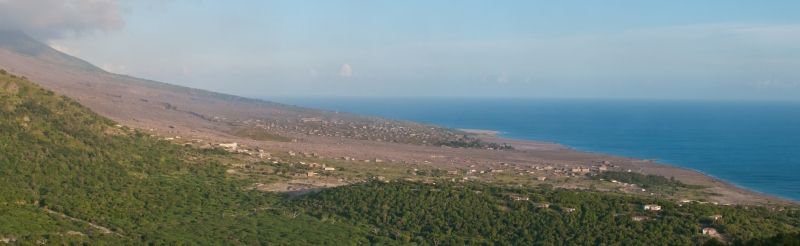
Then awoke the Soufrière Hills volcano in 1995 – this
previously-dormant volcano suddenly erupted for the first time in the nineteenth century and changed the landscape of this small island permanently. With Soufrière
Hills still active today, it’s hard to not mention the words ‘Montserrat’ and
‘volcano’ in the same conversation.
Today, the Montserrat that I live and work in is vastly
different from when the former capital Plymouth was still standing. Now, with
more than half of the island in the exclusion zone, the population has declined
from 10,500 to 4,800. While the islanders are ever so friendly with a resilient
smile, they too feel the after-effects of this massive brain drain that
happened along with the mass evacuations. Industries such as engineering,
medicine, environmentalism and education have suffered, with little or no
specialists in their respective field on the island.
Still, Montserrat exudes a numinous sort of charm, which was
first evident when I was flying in from Antigua on a seven-seater
Britten-Norman Islander. Montserrat loomed in the distance, in a fashion that
would not be out of place in a certain television series featuring a mysterious
tropical island. The reason that took me across the Atlantic was because I
responded to a call – Sir George and Lady Judy Martin were looking to send a
music specialist to Montserrat to, in simplest terms, inspire young people to
take on music. And I went.
With a job description as vague as that, I was wielding a
double-edged sword – I could plan and execute countless possibilities of music
education programmes, but at the same time not knowing what support I would
receive and what response I would get. Thankfully, being given tabula rasa in this sense allowed me to
bite the bullet and start where I was most needed – in the secondary school.
Montserrat has only one secondary school, with no formal
scheme of music education in place before I arrived. And within 48 hours of
boots touching the ground, I was tasked with planning and delivering the
national music curriculum in the secondary school, running after-school music
activities as well as wider-ops styled workshops for students and CPD sessions
for professional musicians.
Demand for instrumental teaching continues to grow,
and lots of opportunities have opened up for expansion of music education on
the island. I continue to set-up and support different music ensembles on the
island that deal with young people, as well as raise awareness and highlight
the necessity of music education within the school system.
Montserrat certainly has a definitive legacy in recording
industry, and while most of it has been lost with the eruption of the volcano,
the community is working hard to restore it to its former glory. Projects such
as the one I’m working on serve to build on that, giving the young people
living here not only an avenue to explore their own musicality, but to take
what they discover with them far and wide into the future.
Currently, this project is sponsored and supported mainly by
The Montserrat Foundation (UK), of which Sir George and Lady Judy Martin and
both foundation trustees. It is also assisted by the Government of Montserrat,
and the Rotary Club of Montserrat. I have been fortunate to be able to raise
more funds to procure more music resources for the island, all of which are
much-needed. Piano books, hand percussion instruments, and small things like
rosin and valve oil - which, while you would ordinarily get any other music
store back home, cannot be found here and must be specially ordered in.
A lot of expats who have lived here for awhile will say Montserrat
is amazing to visit, but sometimes a challenge to live in. Whilst avoiding the
pitfall of calculative weighing of the pros and cons of such a situation, I
must add that having a purpose whilst living here does make it more enjoyable,
and in this case it has certainly proven to be a worthwhile effort. In one
month you could be playing your first ever public steel pan gig, dance behind a
truck loaded with massive speakers moving at half a mile an hour (this is
called a jump up!), join in onstage with a Caribbean string band, or bet on
your favourite caprid at the next goat race.
Earlier in the week I had the pleasure of heading over to Isles Bay to have dinner with Gordon and Sylvie Young, who are currently on island for a short break. Gordon is the chairman of The Montserrat Foundation (UK), which, of course, is the charity that has been managing this entire project. After some very fine, exquisite French fare (whipped up by Sylvie herself, no less) - which is certainly a treat in these places - Gordon put on a DVD of Music for Montserrat, a concert which was held on 15 September 1997 at the Royal Albert Hall.
What so special about this concert was that it featured a plethora of famous musicians who previously recorded at AIR Studios in Montserrat, including Phil Collins, Sting, Eric Clapton, Elton John, Paul McCartney, Carl Perkins and Paul McCartney. Music for Montserrat was arranged and produced by Sir George Martin, and proceeds from the concert were used for disaster relief after a major eruption of the Soufrière Hills volcano the year before. These musicians agreed to appear, out of their own pocket, to raise the necessary funds for the sake of Montserrat. Below is a video of the show's finale, featuring a line-up of stellar artists singing Hey Jude. If anyone could have brought the likes of Sting, Elton John, Paul McCartney, Eric Clapton and so many more together on-stage to perform at the same time, it would have had to be George himself.
AIR Studios in Montserrat was also set up by Sir George Martin, who himself fell in love with (and still continues to play a huge part in the development of) Montserrat. It's main purpose was meant to be a get-away-from-it-all sort of studio, and saw many famous faces walk through its doors until it was finally destroyed by Hurricane Hugo in 1989.
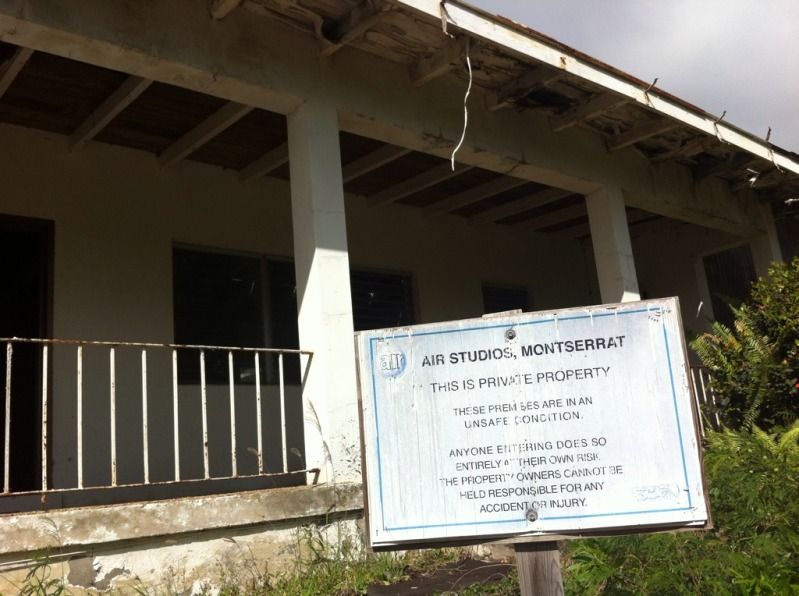
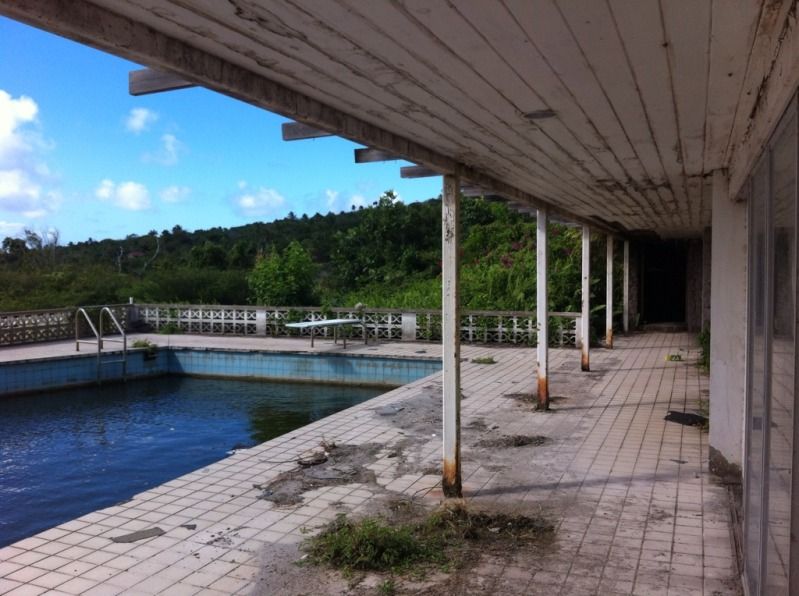
Over the weekend I had the chance to visit what now remains of AIR Studios, located near the Belham Valley. It certainly looks like a ghost of its former self, but one can still certainly appreciate the legacy and the charm it must have held over its many visitors.
The entrance of AIR Montserrat.
Pool included for all those recording breaks.
All that's now left.
It is a somewhat of a shame that a lot of the island's music legacy as been lost on the young people here today, as I have observed from my classes. If only the government here could put in a bit more effort in restoring that by starting to spread awareness of the pivotal role Montserrat once played in - if not the development then at least the production - of what we would call iconic rock music today, I am sure the young people here would embrace it proudly.
Things like putting the Montserrat Cultural Centre to better, more intensive use would only serve to benefit the island's heritage. The only time I stopped by at the centre, the second day I got to the island, it was completely locked shut and the area behind the centre looked slightly overgrown. Yet the Montserrat Tourist Board lists the Cultural Centre as one of the tourist spots to visit. This place could be a perfect location to continue the legacy of AIR Studios and the Beatles - to set up a permanent, constantly-manned exhibition might be a good start.