Showing posts with label charm. Show all posts

Thursday, July 12, 2012

Islands & Treks

Having now almost completed my stint here in Montserrat, I have been recently reading up more about the other British Overseas Territories and trying to get a feel of the infrastructure of music education in other OTs. My work here has been, if not inspiring for the students, then very much so for myself. And one of the long-term ideas that I've allowed to fester in my mind has been one that involves collaboration amongst music students in all the different OTs around the world.

Of course, I am certain the potential groundwork seems massive - but having lived in a small(ish) island community, leading and supporting music education schemes, I must admit it is very relentless but rewarding work. Montserrat is only but one of the 14 OTs around the world, ranging from large, populated islands like Bermuda and the Cayman Islands - both well known for tourism and the occasional tax evasion - to smaller, isolated islands such as the Falkland Islands and Pitcairn Islands.

At pop. 67 (2011 est.), Pitcairn is the least populous jurisdiction in the world. The main island is the only inhabited one, with three other small islands making up the group of Pitcairn Islands. With no airstrip and a nearly-perpetually tumultuous bay, the only access to the island is an overnight journey by sea from the other nearest landmass, Mangareva, French Polynesia - 300 miles away. The regular ship that services the island (bringing island stores and occasionally, tourists) makes only two return trips every three months.

There is only one school on the island (pre-school and primary), with what I guess appears to be between 5-7 pupils overseen by a qualified teacher appointed from New Zealand. Each teaching contract in Pitcairn lasts for two years, and other duties include editing the Pitcairn Miscellany, a monthly newsletter filled with island happenings, ship arrivals and local gossip.

And it's this newsletter that I have been rather absorbed with recently - it's like reading a local newspaper about a family living in a somewhat Swiss Family Robinson-esque fashion. Add that to Pitcairn's somewhat illustrious history - Pitcairners are mostly descendants of the Bounty mutineers and the Tahitians who accompanied them - and charming isolation, I have been quite fascinated with the inner workings of such a close-knit community. Which brings me back to the idea of possibly setting up some form of collaborative project with the students on Pitcairn, perhaps starting with my new students in my upcoming job at St John's next academic year.

For those who might be interested in a glimpse of a country populated by only (approx.) 67 people, sharing a newly-upgraded 1 Mbps satellite internet connection and living with 14-hour electricity cycle per day and only one privately-owned car on the island, you can read the latest copy of the Pitcairn Miscellany which I have uploaded here. Regular subscription costs US$15 per year. Pitcairn is now trying to expand tourism to the island, reaching out to the numerous cruise ships that sometimes call whilst traversing the Atlantic. However, access to the bay is extremely weather-dependant and it's never a guarantee that you will be able to set foot on the island after your lengthy journey.

Of course, if you think the work gossip in your office building was bad enough, think again. Pitcairn is also no stranger to controversy, having come into the spotlight for the 2004 sexual assault trials where charges were laid against seven men living on the island and six living abroad, including the island's mayor at that time. All but one of the defendants were found guilty, some with multiple counts of sexual attacks of children, and were housed in a converted prison set up by the British government. Particular consideration in sentencing had to be given due to the fact that if too many able-bodied men were incarcerated for too long, the island would essentially cease to function properly. Talk about a serious case of cabin fever.

The beguiling charm of Pitcairn still holds steadfast, however, and short of obtaining my own sailing yacht and traipse across the Atlantic, I shall content myself to the role of couch traveller and perhaps get to work on seeing that collaborative project through. Who knows, if this is successful, the next step could be Ascension Island (pop. 1,122) or Tristan da Cunha (pop. 264). Interestingly, Tristan da Cunha, while being the most isolated inhabited island in the world, already has an ongoing music collaborative project between the island's school and amateur composers in England, led by a certain music teacher named Tony Triggs.

In other more local news, I have been doing a bit more trekking around Monty, doing some last-minute exploration of nature before I leave. Last Sunday, Sonja kindly agreed to take me on the trail to the dry waterfall, with Pepper tagging along. It was a mildly easy, 3-hour return trek which culminated with the dry waterfall looming over a the wide and rocky Soldier Ghaut - most impressive. A few photos from the morning.
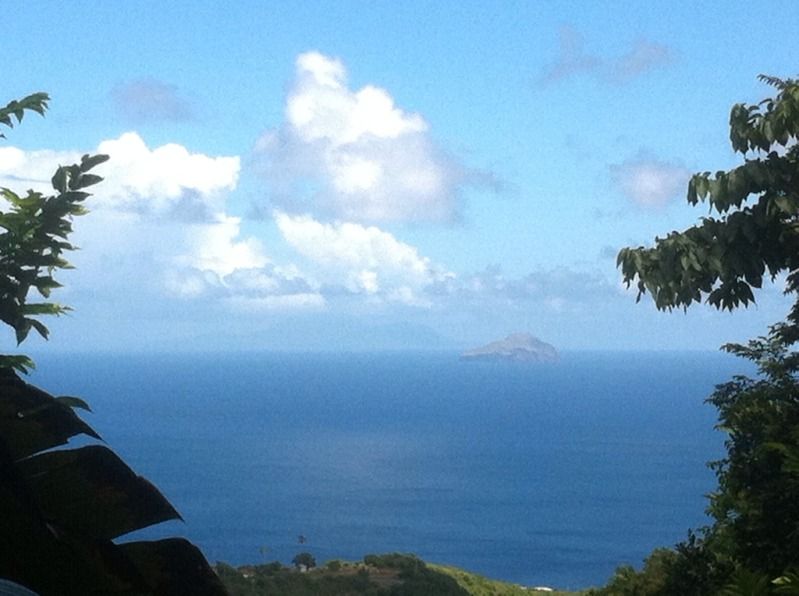
An exceptionally clear day: Redonda out at sea, with Nevis just faintly beyond.

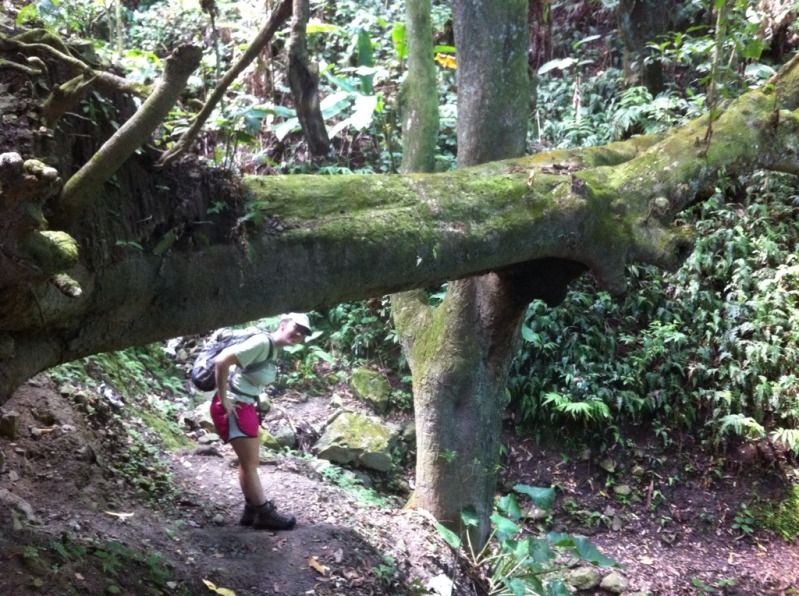
Sonja ducking under the two 'kissing' trees.
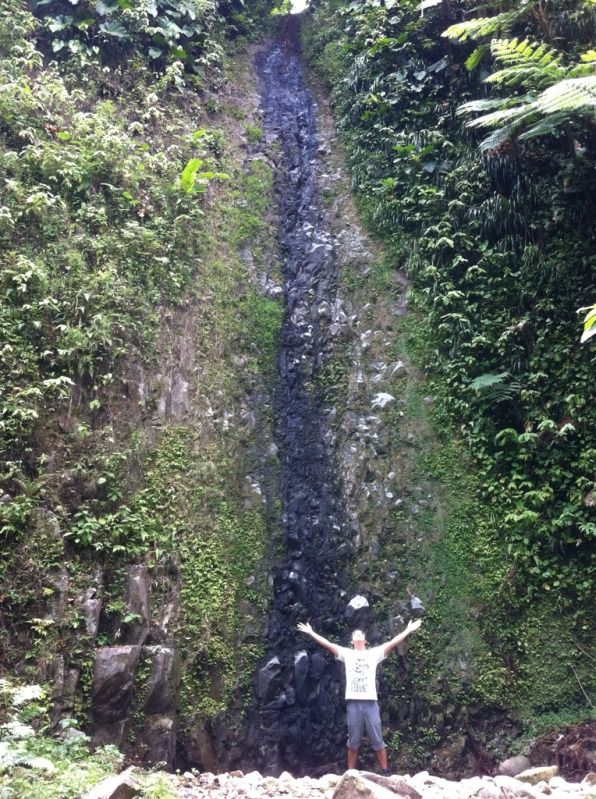
Arrival at the dry 100-ft waterfall.

This Friday, Em, Gerren & I are attempting to trek up Katy Hill, the tallest peak in the Centre Hills. Trés bien.

Friday, June 29, 2012

Write-ups & Recollections

About a month and a half ago I was invited to write down my experiences on Montserrat for the Guildhall School's student and alumni magazine, in order to give prospective applicants a brief introduction to life here. Now that it's been published, I'm reproducing it on the blog here.

Black sand beaches, goat racing and a volcano in the backyard, occasionally shrouded in mystic cloud cover. It’s no wonder Sir George Martin was enthralled by this place when he first visited in the seventies, enough so that he would then go on to set up AIR Studios Montserrat in 1979. And before the studio’s tragic demise during Hurricane Hugo in 1989, Montserrat was graced by a stellar line-up of artistes such as Sting, Elton John, Paul McCartney and Phil Collins, all of whom enjoyed recording in this paradise isle whilst enjoying a relative level of anonymity which could not be found in the big cities.
Then awoke the Soufrière Hills volcano in 1995 – this previously-dormant volcano suddenly erupted for the first time in the nineteenth century and changed the landscape of this small island permanently. With Soufrière Hills still active today, it’s hard to not mention the words ‘Montserrat’ and ‘volcano’ in the same conversation. 
Today, the Montserrat that I live and work in is vastly different from when the former capital Plymouth was still standing. Now, with more than half of the island in the exclusion zone, the population has declined from 10,500 to 4,800. While the islanders are ever so friendly with a resilient smile, they too feel the after-effects of this massive brain drain that happened along with the mass evacuations. Industries such as engineering, medicine, environmentalism and education have suffered, with little or no specialists in their respective field on the island. 
Still, Montserrat exudes a numinous sort of charm, which was first evident when I was flying in from Antigua on a seven-seater Britten-Norman Islander. Montserrat loomed in the distance, in a fashion that would not be out of place in a certain television series featuring a mysterious tropical island. The reason that took me across the Atlantic was because I responded to a call – Sir George and Lady Judy Martin were looking to send a music specialist to Montserrat to, in simplest terms, inspire young people to take on music. And I went. 
With a job description as vague as that, I was wielding a double-edged sword – I could plan and execute countless possibilities of music education programmes, but at the same time not knowing what support I would receive and what response I would get. Thankfully, being given tabula rasa in this sense allowed me to bite the bullet and start where I was most needed – in the secondary school. 
Montserrat has only one secondary school, with no formal scheme of music education in place before I arrived. And within 48 hours of boots touching the ground, I was tasked with planning and delivering the national music curriculum in the secondary school, running after-school music activities as well as wider-ops styled workshops for students and CPD sessions for professional musicians. 
Demand for instrumental teaching continues to grow, and lots of opportunities have opened up for expansion of music education on the island. I continue to set-up and support different music ensembles on the island that deal with young people, as well as raise awareness and highlight the necessity of music education within the school system. 
Montserrat certainly has a definitive legacy in recording industry, and while most of it has been lost with the eruption of the volcano, the community is working hard to restore it to its former glory. Projects such as the one I’m working on serve to build on that, giving the young people living here not only an avenue to explore their own musicality, but to take what they discover with them far and wide into the future. 
Currently, this project is sponsored and supported mainly by The Montserrat Foundation (UK), of which Sir George and Lady Judy Martin and both foundation trustees. It is also assisted by the Government of Montserrat, and the Rotary Club of Montserrat. I have been fortunate to be able to raise more funds to procure more music resources for the island, all of which are much-needed. Piano books, hand percussion instruments, and small things like rosin and valve oil - which, while you would ordinarily get any other music store back home, cannot be found here and must be specially ordered in. 
A lot of expats who have lived here for awhile will say Montserrat is amazing to visit, but sometimes a challenge to live in. Whilst avoiding the pitfall of calculative weighing of the pros and cons of such a situation, I must add that having a purpose whilst living here does make it more enjoyable, and in this case it has certainly proven to be a worthwhile effort. In one month you could be playing your first ever public steel pan gig, dance behind a truck loaded with massive speakers moving at half a mile an hour (this is called a jump up!), join in onstage with a Caribbean string band, or bet on your favourite caprid at the next goat race.